
The corporate world has always been about competing and making a profit, which contributed to a corporate culture disconnected from the actual impact of businesses on society, which has now been turned upside down. Global stakeholders such as investors, policymakers, customers, and the communities where companies operate want more than compliance—they want supported actions intended to bring about change. Net Zero commitments are a good starting point, as companies still look at their ESG checklist and look for deep decarbonization solutions.
But, do you know, why are companies still focusing on ESG metrics? Why do they take pride in annual compliance reporting and a climate-constrained world?
Let’s discuss!
At a high level, ESG certification and reporting frameworks allow companies to measure, disclose, and enhance performance in a business over a specified timeframe within the following three pillars:
The ESG framework has established itself as a key standard in the reporting and management of non-financial business performance. ESG is used by investors to evaluate potential long-term exposure to risk, by regulators who use ESG disclosures to inform policy, and by companies that use ESG certification as proof of accountability.
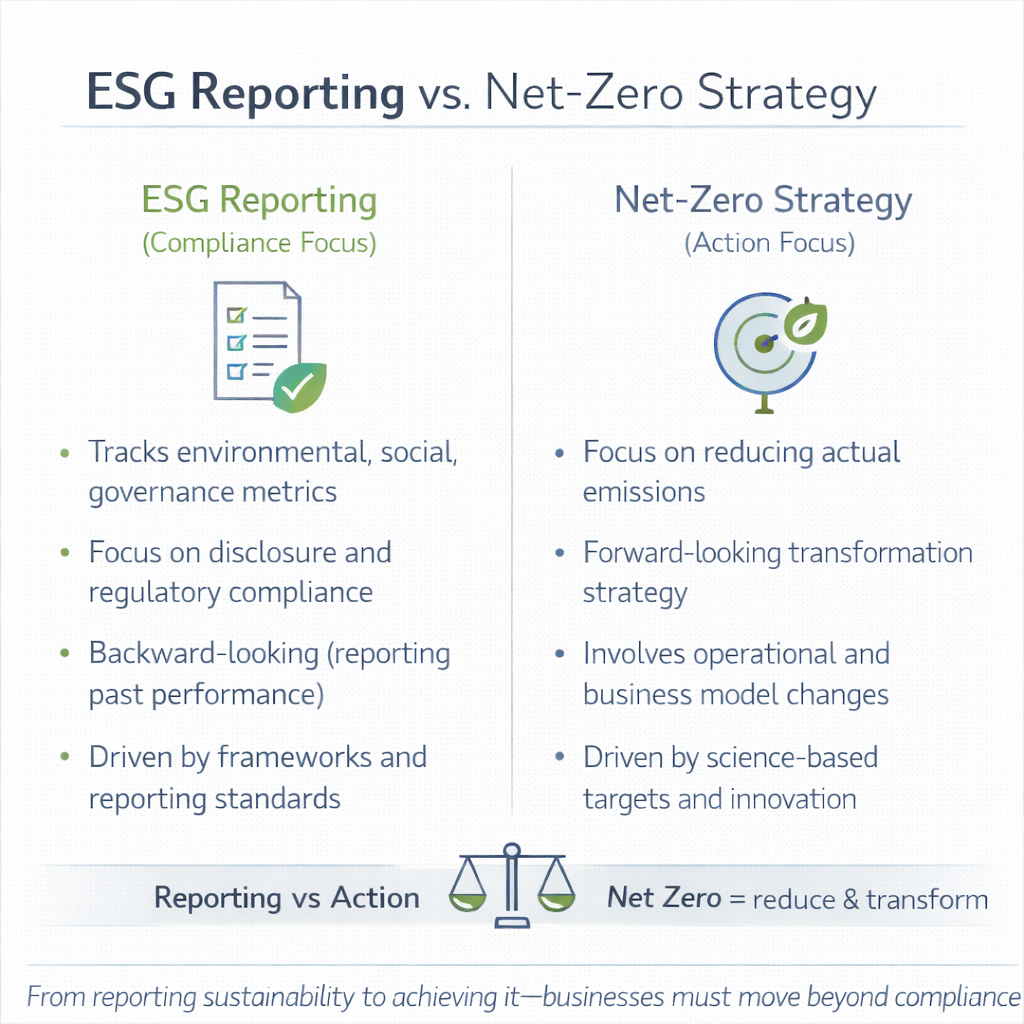
However, it has its own shortcomings. Reporting frameworks like the GRI, SASB, or the ones by TCFD focus predominantly on the current or historical state of performance. They focus on the degree to which companies meet standards, but rarely outline the transformational steps necessary to achieve a climate-stable economy.
Simply, ESG provides a current snapshot of a company, but offers little in the way of future direction.
Net Zero, in contrast, is not an ESG reporting exercise. It is a commitment to achieving a balance between GHGs (Greenhouse Gas) emitted and those removed from the atmosphere. The majority of Net Zero roadmaps maintain alignment with the Paris Agreement aim of no more than 1.5°C global warming.
For the world of business, this translates to:
Net Zero, unlike ESG reporting, is not an exercise in historical data collection. Targets are futuristic, anchored to deadlines and to scientific rationale. They not only require compliance but a fundamental rethinking of business models, supply chains, and capital allocation strategies.
1. The Risk of Greenwashing
Diverse ESG reporting regions and rating agencies enable a company to keep up a carbon-intensive reputation and ESG scoring concurrently, even if they score high on how they report ESG practices. Stakeholders and other audiences place carbon emissions on a higher pedestal, often ignoring the importance of the ESG score.
2. Investor Expectations Have Shifted
Leading Funds, Sovereign Wealth, and some of the largest Banks in the world are increasingly unwilling to invest if they do not receive a Net-Zero aligned transition plan. ESG-certified practices without a clear Net-Zero plan are far too common, which makes the entire investment portfolio look zig-zag or reactive, not strategically planned.
3. Regulatory Pressure Is On The Rise
Regulation has followed in the footsteps of corporations, from the EU’s Corporate Sustainability Reporting Directive (CSRD) to the SEC’s climate disclosure rules in the US, which have already mandated the submission of forward-looking emissions data. ESG compliance reporting has to correlate with the pathways to Net-Zero because non-compliance will have severe penalties.
4. Market Differentiation Requires Leadership
B2B customers are integrating Net-Zero goals in streamlining their vendor selection process. Only reporting ESG targets leaves most corporations stagnant and with little growth, which is why they have to shift to demonstrating real progress across the value chain.
In contemplating ESG and Net Zero, it would be incorrect to regard them as frameworks in conflict. ESG forms the baseline compliance and transparency structure, whereas Net Zero determines the transformative strategy. Together, they provide a formidable road map to sustainability:
This approach guarantees that corporations do not merely report sustainability, but embrace it.
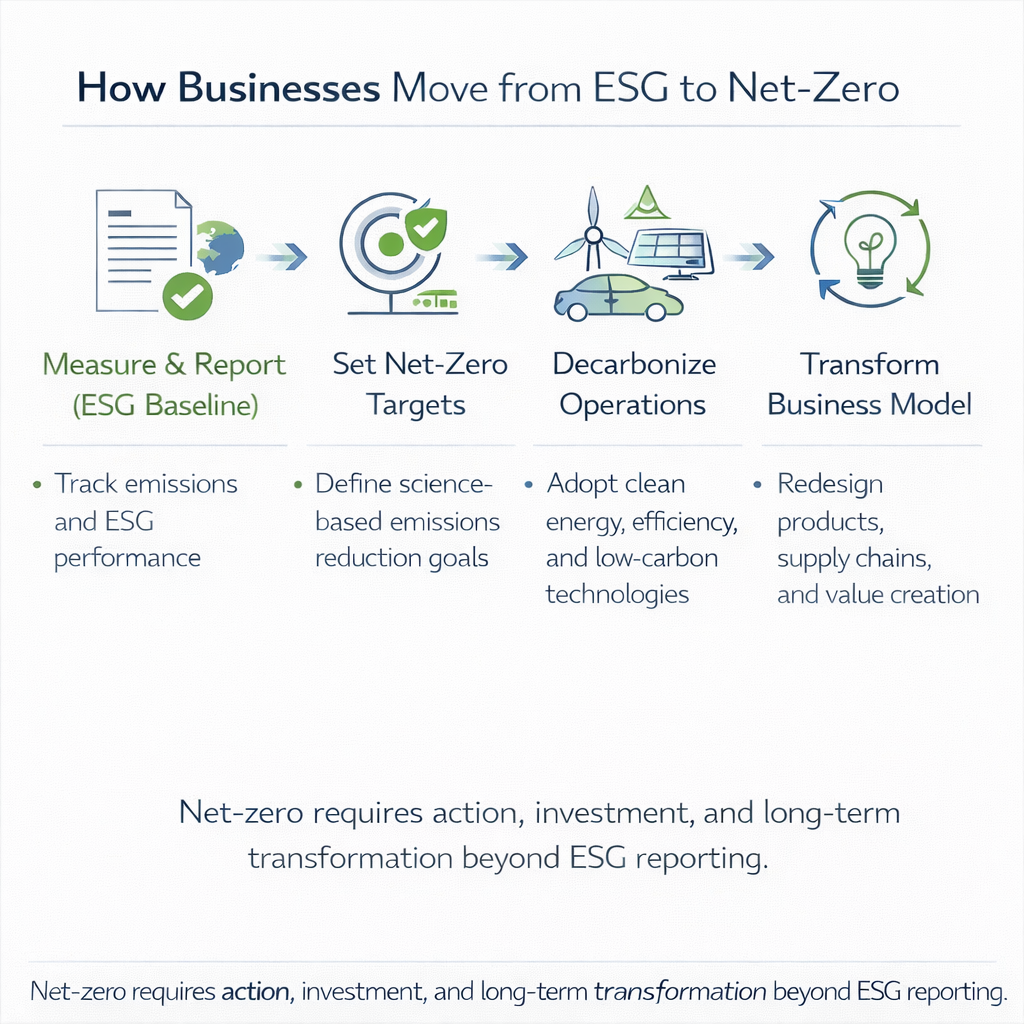
Net Zero aims to achieve much more than data and dissemination. There is a need for erudition that marries sustainability strategy to functionality in ESG, decarbonization, climate risk management, and green innovation opportunities.
Specialized curricula, such as those offered by evACAD, explicitly tailor a scholar’s professional profile to desired outcomes. One such example is the PG Executive Program in Net Zero Strategy & Sustainability Leadership, run in partnership with IIM Kashipur. It enables professionals to transition from just ESG reporting compliance to a Net Zero strategy, aiming at:
These skills will not only enhance one's career but also significantly shape and powerfully influence one's career prospects in the green future.
Sustainability has now become more than just an exercise in reporting and is fully embraced with ESG certification. While ESG certification does have significance, but it needs to evolve into a more foundational element for an organization transitioning towards Net Zero. Organizations that treat ESG as merely an exercise in fulfilling a necessary task will fall behind those that combine Net Zero science-based commitments with fulfilling ESG obligations.
Proactively, the future will be owned by the leaders who can steer and manage the two simultaneously.
At evACAD, we prepare industry-relevant programs to focus on future sustainability leaders. Check out our PG Executive program, designed to help you play a vital role in transforming your industry for a sustainable future.


.webp)
.jpg)
.jpg)