
When India entered the sovereign green bond market in January 2023, it marked a defining moment in the country’s sustainable finance journey. The launch of green bonds signified India’s formal integration of sustainability into its fiscal architecture. For a fast-growing economy grappling with climate vulnerability, this step was both a reputational milestone and a financial innovation.
Now, with two successful rounds completed and over ₹16,000 crore (about USD 1.8 billion) raised, the key question is: what have we learned, and what lies ahead? According to the World Bank, India’s entry into the sovereign green bond space reflects its intent to embed climate priorities into national financial systems.
Sovereign green bonds (SGBs) are debt instruments issued by the government to finance environmentally sustainable public expenditure. While over 40 countries have issued such bonds globally, yet India’s approach is distinctive. The country has focused on strategic sectoral priorities while deliberately building a domestic green bond market. As noted by the Center on Global Energy Policy, Columbia University, India’s issuance supports its broader decarbonization and energy-transition agenda.
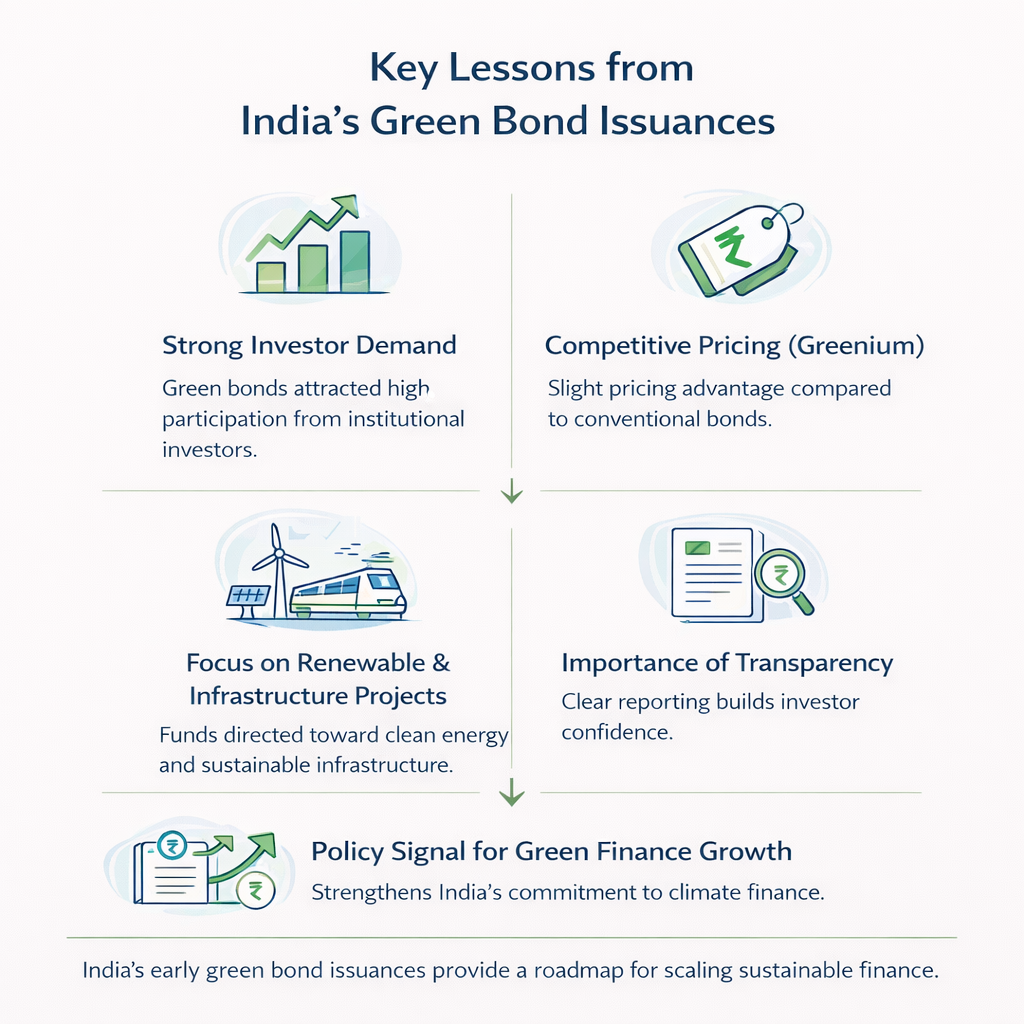
India’s debut sovereign green bond issuance of ₹8,000 crore in January 2023 was oversubscribed, demonstrating strong investor confidence. Institutional investors, including banks, mutual funds, and ESG-focused global entities, participated enthusiastically, as reported by The Indian Express.
The funds were allocated to public-sector projects in renewable energy, clean transport, sustainable water and waste management, and climate adaptation. A World Bank case study highlights that India aligned its Green Bond Framework with the International Capital Market Association (ICMA) Green Bond Principles. The government also established a Green Finance Working Committee under the Ministry of Finance to ensure governance and oversight.
Unlike many global issuers who used green bonds to address budget deficits, India issued them within its existing borrowing limits. This demonstrated fiscal prudence while testing market appetite. The Press Information Bureau (PIB) emphasized that India’s framework enhances investor trust and lays the foundation for scaling up green finance through municipal bonds and blended instruments.
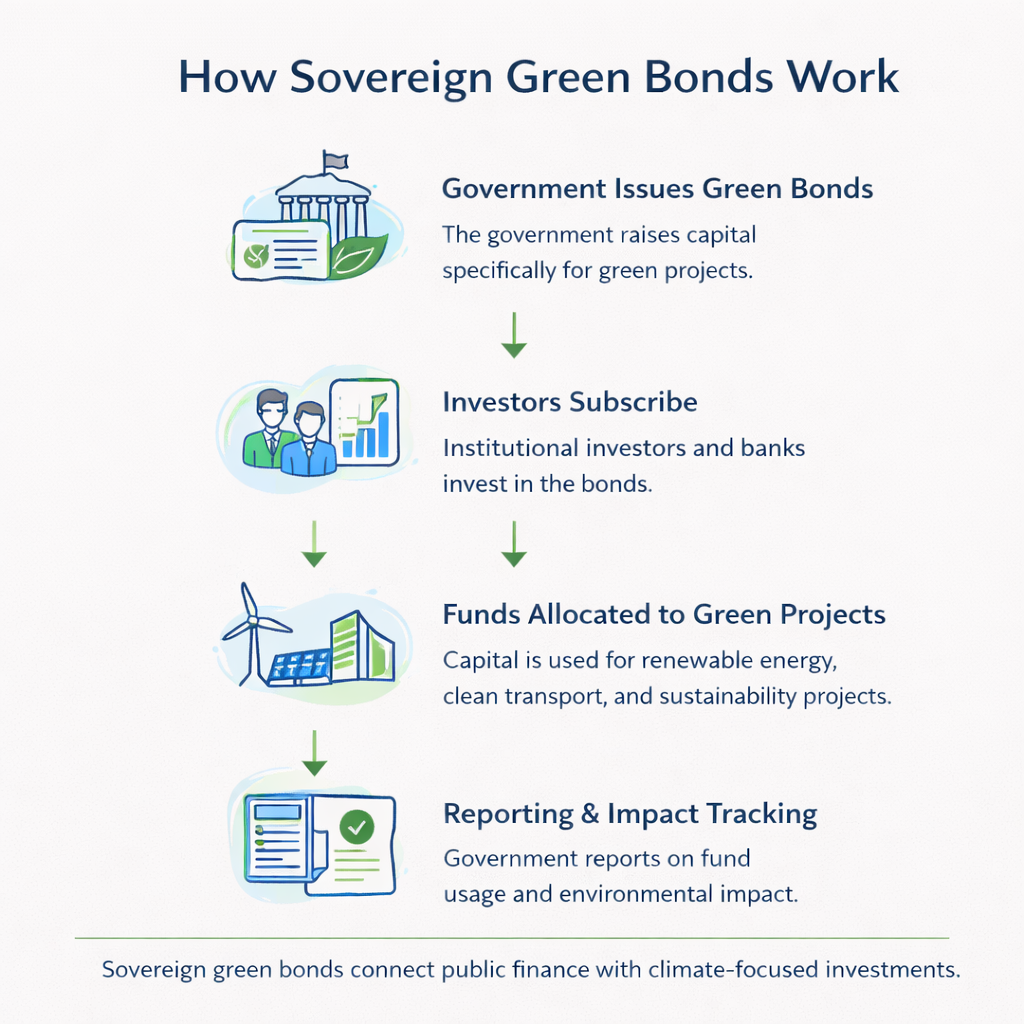
Transparency in the use of proceeds should be a hallmark of sovereign green bonds. India’s funds have been directed toward:
These sectors reflect India’s national priorities - low-carbon energy, just transition in agriculture, and climate-smart infrastructure. As highlighted by ORF Online, India’s inclusion of adaptation finance is particularly noteworthy, given that over 600 million Indians depend on climate-sensitive sectors.
The exclusion of nuclear and large hydro projects aligns India’s framework with global environmental standards and ensures credibility with international investors. Reuters noted that this approach enhances India’s position in global ESG finance by prioritizing clean technologies and climate-resilient investments.
The market reception was overwhelmingly positive. Both 5-year and 10-year tranches were priced favourably, with a small “greenium”; investors accepted slightly lower yields for climate-aligned securities, according to Structured Finance in Brief.
Importantly, the sovereign green bonds have catalyzed the broader debt market. Several state governments and public-sector entities, including Kerala, Maharashtra, and REC Limited, have since announced plans for green or sustainability-linked bonds. Private issuers in sectors such as renewable energy, logistics, and infrastructure are also exploring similar instruments.
SGBs are therefore not just fundraising tools but market-making instruments that deepen liquidity and investor participation in India’s ESG-debt ecosystem.
Despite early success, India’s green bond journey is still in its infancy. A key concern is the lack of granular impact reporting. Investors increasingly want measurable outcomes- how many tons of CO₂ were avoided, how much water was conserved, and how many communities benefited. As Outlook Business observed, current disclosures focus more on fund allocation than on quantifiable results.
Project execution risk is another challenge, particularly in sectors such as agriculture and water management, where outcomes depend on local participation and hard-to-ascertain metrics. Strengthening monitoring and verification systems will be crucial for scaling issuance of SGBs. Additionally, if project pipelines are not ready or deployment is delayed, investor confidence may weaken. Integrating green public investment planning into national climate and fiscal policy is also essential to sustain momentum.
The IIM Kashipur PG Executive Program in Net Zero Strategy & Sustainability Leadership, offered in collaboration with evACAD, offers a close view of the development of such transformative financial mechanisms and climate leadership. The program explores the dynamics of instruments like sovereign green bonds, sustainability-linked loans, and carbon-market frameworks.
Participants learn to evaluate green bond frameworks, assess ESG credibility, interpret green taxonomies, and integrate sustainability into corporate finance. Designed for mid- and senior-level professionals across finance, policy, and energy sectors, the program empowers leaders to design and implement sustainability strategies aligned with India’s Net Zero 2070 commitment.
The real success of India’s sovereign green bonds will depend on their evolution. Future rounds should aim for deeper market integration, stronger impact measurement, and participation from local governments. As India moves toward a green industrial revolution built around green hydrogen, circular economy models, and clean energy transitions, innovative financial instruments such as sovereign green bonds can evolve from being symbolic instruments to systemic enablers.
In doing so, India not only raises capital but also builds global investor confidence-perhaps the most valuable currency in the climate economy.


.webp)
.jpg)
.jpg)