
Explore
Energy storage technologies have become prominent over the years and will play an increasingly crucial role in India’s Net Zero ambition. Although lithium-ion battery technologies have been the dominant and most well-known technology in the market, the future holds promise for newer classes of storage technologies that offer greater flexibility, scalability, sustainability, and resilience.
With these storage technologies, India is expected to integrate a higher percentage of renewable energy more efficiently and reduce reliance on imported minerals.
So, what are the options we have? Let’s discuss them in brief.
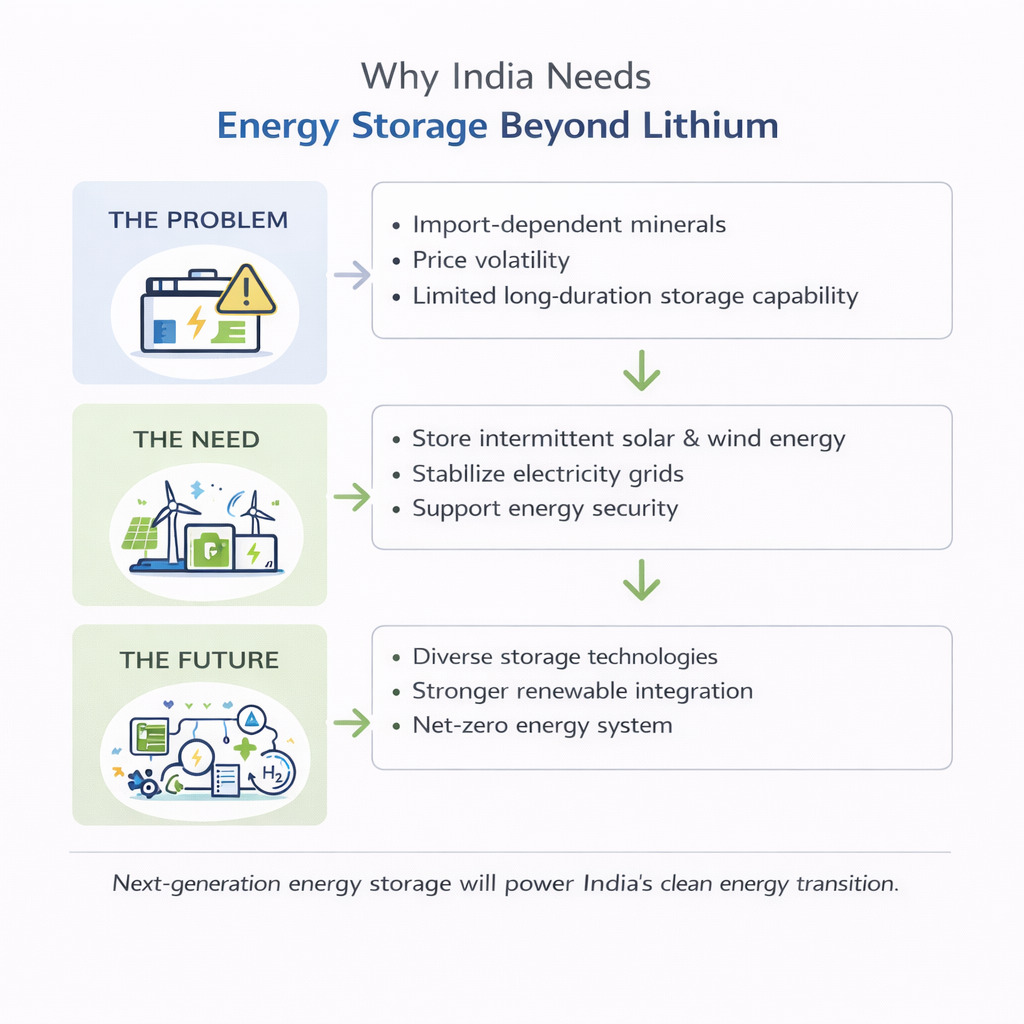
First, we should understand why we need an alternative to the most common energy storage technology on the market. Lithium-ion batteries have catalyzed the first phase of India's clean energy transition, especially in electric vehicles and utility-scale battery storage. But scaling them further involves some challenges. Also, one will face supply chain vulnerabilities because lithium and cobalt are import-intensive. Moreover, the prices of these materials fluctuate, making cost competitiveness difficult. Lastly, conventional lithium batteries are not well-suited for long-duration storage.
A report shows that India’s energy storage market will face tensions if the growth in energy storage contracts reported by IEEFA continues, as 6.1 GW of energy storage tenders were released in 2025 Q1. Issues with the supply chain, financing, and other factors will remain the primary barriers to growth.
So, to strengthen its energy transition and reach its target of 500 GW of non-fossil energy by 2030, India needs to broaden its capabilities in energy storage technologies. And the only option available is to look for other energy storage technologies beyond lithium.
But finding a promising alternative is not a simple task. There are a number of pros and cons involved. Here are some of the most promising emerging storage technologies that could support India’s net-zero transition:
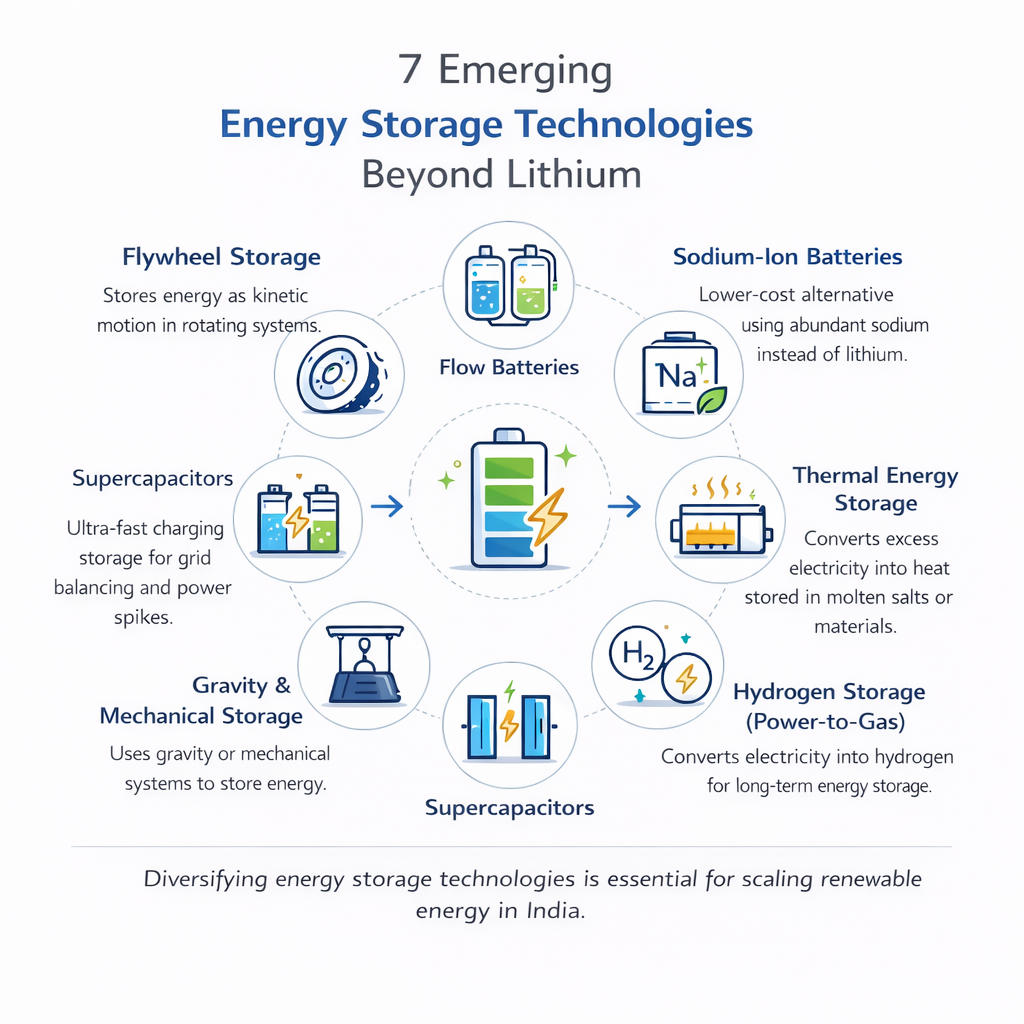
1. Flow batteries
Vanadium flow batteries store energy as a liquid electrolyte in large external tanks. This design makes them highly scalable and ideal for long-duration storage. Unlike other batteries, flow batteries can scale power and energy capacities independently. Vanadium flow batteries have a longer lifecycle and possess industry safety advantages. In India, flow batteries could be key to microgrids, rural electricity, and the grid, enabling energy storage.
2. Sodium-Ion Batteries
Sodium-ion batteries use sodium, a cheaper, more abundant element, instead of lithium. While the energy density of these batteries is still lower than that of lithium-ion batteries, with technological advancements the gap is decreasing, and for stationary applications, the batteries are more appealing from a cost and sustainability perspective.
3. Thermal (Heat) Storage and Carnot Batteries
In thermal energy storage, excess electricity is converted into heat and stored in materials such as molten salts or phase-change materials. A newer variant of these technologies is the Carnot battery, which stores heat and later converts it back into electricity. These systems are likely to be cost-efficient and scalable for India's industrial and grid applications, as they can use locally available materials and lead to a reduction in dependence on critical minerals.
4. Hydrogen-Based Storage (Power-to-Gas)
Hydrogen energy storage utilizes excess power to produce hydrogen through a process known as electrolysis. This is the reason why this energy storage is also known as power-to-gas storage. This method is particularly aligned with India's green hydrogen aspirations, as it supports long-term or seasonal storage.
Hydrogen-enabled power storage, according to the IBEF, can support grid decarbonization and provide clean power during periods of undersupply from renewable energy sources. Notably, in recent times, metal-hydride storage, particularly with metal borohydrides, is an interesting area of research with the potential to provide high energy storage density and long cycle periods.
5. Gravity and Mechanical Storage
Pump Hydro Storage remains a significant form of grid storage in India due to its long-standing, reliable operational history over the years. But other mechanical systems are also being developed for storage, such as using gravitational energy in pumping systems to lift heavy objects during surplus periods and then lower them to generate power during energy-deficient periods. These systems can even be used in regions with limited geographical conditions instead of traditional pumped hydro.
6. Supercapacitors and Flywheels
Another innovative technology - supercapacitors - can be charged and discharged quickly and use electrostatic charging mechanisms to store energy. Yet another - flywheel systems - use a rotating rotor to store energy as kinetic energy. All these tech systems are being tested and developed for smart grids and functions such as balancing energy/load in a grid and short-term energy storage.
7. Emerging & Disruptive Concepts
Quantum batteries are still theoretical. These devices sit squarely within the realm of elusive quantum mechanics and are theorized to provide rapid recharging, very high energy outputs, and deliver power in short intervals. They are the frontier of research for extended-duration storage.
The number of storage alternatives is increasing, but dealing with those storage solutions requires proper knowledge. There is an accelerating need for specialists who understand the technical, economic, and policy implications. This is where education and professional training become essential. The next phase of India’s clean energy transition will not be driven by hardware alone, but by people who can design, evaluate, and implement sophisticated energy storage solutions suited to different grid and industry environments.
Professionals equipped with deep knowledge of storage systems, grid integration, lifecycle impacts, resource economics, and regulatory frameworks will be critical to scaling these technologies responsibly. This is why our BESS Program increasingly integrates advanced modules on flow batteries, hydrogen storage, thermal storage, mechanical storage systems, supercapacitors, and long-duration storage models. Understanding how and where to deploy each technology is becoming a core skill in energy transition planning.
For engineers, policymakers, business leaders, and ESG strategists, mastering energy storage is no longer a niche requirement. It is the defining capability that will enable renewable energy integration and decarbonization across industries. As demand continues to grow for net-zero carbon courses in India, programs that address the technical realities of storage systems will play a vital role in developing the talent needed to accelerate large-scale adoption and bridge the gap between policy commitments and practical implementation.
Scaling next-generation energy storage alternatives will not be without challenges. High capital costs, technological maturity, supply chain logistics, and regulatory structures- all pose challenges.
Many of these storage technologies (ESS) are still in the pilot or early commercial phase in India. They will need to be complemented with supportive policies to let them reach scale. Policies on research, incentives, and training should complement financial and deployment strategies in order for this scaling to materialise.
According to IEEFA, India's energy storage market is already transforming, with pump hydro continuing to dominate utility-scale tenders, but investments in standalone systems are increasing rapidly. IEEFA notes that policy incentives and support, particularly to address barriers to emerging storage technologies, have been helpful so far.
To wrap it up, breaking free from lithium dependence is not just a technological choice. It is a strategic imperative for India’s Net Zero future. Emerging energy storage technologies, including flow batteries, sodium-ion chemistry, thermal storage, green hydrogen systems, and mechanical systems, offer diverse opportunities to build a more sustainable and resilient grid.
Growing demand for net-zero courses will enable professionals and decision-makers with knowledge of these innovations to structure the core elements of infrastructure, policy, and business models for these storage technologies. At the same time, the courses must include a deep technical understanding of these advanced storage technologies, so the energy leaders can prepare themselves for the challenges and opportunities.
The adoption of modern energy storage solutions will further facilitate India's long-term decarbonization goals.
The future of storage is not just Lithium. It is diverse, innovative, sustainable, and scalable.


.webp)


%20(1).png)
%20(1).jpg)
%20(1).jpg)